Friday, 10 September 2010


Thursday, 2 September 2010
Stephen Hawking: God did not create Universe
He had previously argued belief in a creator was not incompatible with science but in a new book, he concludes the Big Bang was an inevitable consequence of the laws of physics.
The Grand Design, part serialised in the Times, says there is no need to invoke God to set the Universe going.
"Spontaneous creation is the reason there is something," he concluded.
'Planetary conditions'
In his new book, an extract of which appears in the Times, Britain's most famous physicist sets out to contest Sir Isaac Newton's belief that the universe must have been designed by God as it could not have sprung out of chaos.
Continue reading the main story
Citing the 1992 discovery of a planet orbiting a star other than our Sun, he said: "That makes the coincidences of our planetary conditions - the single Sun, the lucky combination of Earth-Sun distance and solar mass - far less remarkable, and far less compelling as evidence that the Earth was carefully designed just to please us human beings."
He adds: "Because there is a law such as gravity, the universe can and will create itself from nothing.
"Spontaneous creation is the reason there is something rather than nothing, why the universe exists, why we exist.
"It is not necessary to invoke God to light the blue touch paper and set the universe going."
The book was co-written by US physicist Leonard Mlodinow and is published on 9 September.
In his 1988 bestseller, A Brief History of Time, Prof Hawking appeared to accept the role of God in the creation of the Universe.
"If we discover a complete theory, it would be the ultimate triumph of human reason - for then we should know the mind of God," he said.
http://www.bbc.co.uk/news/uk-11161493
Wednesday, 1 September 2010
Kerala, Asia's best travel destination
Even as Kerala is named the best travel destination in Asia, we bring you 25 reasons to visit God's Own Country. That is, if you haven't already.
Kerala Tourism got a boost when the million-plus readers of the acclaimed travel portal, SmartTravelAsia.com, placed the state as the best Asian holiday destination ahead of Bali, Phuket and the Maldives in a poll conducted over 3 months across Asia (India, Singapore, Australia, Hong Kong, China, Japan, Malaysia, Thailand, Philippines, and the Middle East), Europe and North America.
"This is a phenomenal recognition for Kerala and the people who are working in the tourism sector," said V. Venu, secretary, Kerala Tourism.
The only other Indian destinations to be listed in the top 10 were Rajasthan and Goa - at eighth and 10th spot respectively.
So, here's why you should pack your bags and get those tickets for Kerala.
read this MSN article: http://news.in.msn.com/gallery.aspx?cp-documentid=4327531
Thursday, 19 August 2010
Transformed into the Likeness of Christ
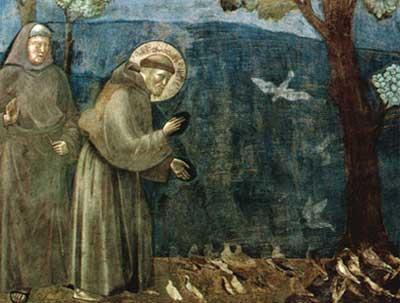
The Conversion of St. Francis of Assisi
By: Jeanne Kun
How did the son of a wealthy merchant become the town beggar? What would prompt a popular young bachelor to start talking dreamily about “Lady Poverty”? What would cause a carefree “King of Feasts” to abandon the party scene and spend his time rebuilding a ramshackle old chapel stone by stone?
The story of Francis of Assisi’s conversion is the story of how deeply God can change a human heart. And it is the story of one man’s response to God’s call—a response that was at times uncertain and searching, at times anguished, yet always wholehearted.
Seeking Adventure and Fame
Born in Assisi in central Italy sometime during 1181 or 1182, Francis was the son of Pietro de Bernardone, and his wife, Pica. As heir to Pietro’s prosperous cloth business, Francis enjoyed wearing fashionable clothes made from his father’s inventory and entertaining his friends with lavish meals. He was captivated by stories of knights in shining armor and longed for the day when he would ride gloriously into battle. High-spirited and generous, Francis was a favorite among his peers. But when he was about twenty years old, his life took a turn that began to reveal to him its emptiness.
In 1202, Francis joined his townsmen in a petty war against the neighboring city of Perugia. It was his “big chance” as a knight, but the adventure ended in defeat. He spent a year in captivity, where he kept up the spirits of his fellow inmates with his good-natured patience and cheerful songs. After his release, Francis suffered a prolonged fever. During his convalescence, he had time to think about his life and the things of eternity. But his desire for adventure was still strong. When he did recover, he joined a company of knights serving the Pope.
Francis set off for battle again in 1205, but another illness dashed his hopes. In a feverish dream, he heard a voice asking, “Who do you think can best reward you, the master or the servant?” “The master,” Francis answered. The voice then replied, “Then why do you leave the master for the servant, the rich Lord for the poor man?” Francis returned home, uncertain what the dream meant, but convinced that God was speaking to him.
Won by Lady Poverty
Back in Assisi, Francis took up his familiar pastimes, but his heart was no longer in them. He began to disdain the old ways and believed that he had wasted his life on trivial and transitory things. Wrestling with himself and searching for his way, he spent hours in intense prayer out in the countryside or in dark caves, all the time seeking to understand God’s will. Slowly, he began to feel a desire to live like Jesus, whom he called the “poor Christ.”
One evening after partying with his friends, Francis experienced a sense of God’s love that was so profound that he felt enraptured. When his friends jested that he had fallen in love, he replied, “Yes, I am thinking of marrying. But the bride I am going to woo is nobler, richer, and fairer than any woman you know.” Francis pledged himself to “Lady Poverty” and chose to live simply, in imitation of the poor Christ who was capturing his heart.
Inspired to go on a pilgrimage to Rome, Francis came face to face with the poverty to which he had pledged himself. In Rome, he exchanged his costly clothes for rags and begged for his bread. Finally, the idealistic troubadour had the chance to put into practice the ideals that had filled his imagination.
Mastered by Love
Francis’ experiment in poverty proved liberating, and, when he returned home, he no longer feared living on the edge of necessity. Still, he knew that more steps lay ahead of him. The final test came a few years later when he caught sight of a man afflicted with leprosy on the road before him. Francis was repulsed by the terrible sight and instinctively retreated. But then he stopped. He felt the time had come to deal with the pride and lack of love inside of him.
Francis turned back and embraced the leper. He kissed the man’s diseased hand and pressed a few coins into it. In this simple act of love, Francis felt his natural aversion to the sick and outcast disappear. Instead, he was filled with such compassion that the next day he gave away money to all the lepers at the local hospital and begged their pardon for having so often despised them.
Francis began to care for the sick, but he also continued to ask God to show him a fuller purpose for his life. One day in 1207, while praying in the ruined church of San Damiano, he heard Jesus speaking to him from the crucifix: “Francis, go and repair my house, which you see is falling down.”
In his eagerness to respond to God, Francis took these words literally and set about repairing the dilapidated chapel. Impulsively, he sold some of his father’s cloth to get money for stones. Pietro, however, wasn’t as thrilled over the liberality with which he treated his father’s stock. Indignant and angry, he hauled Francis before the episcopal court.
On trial before the bishop, Francis performed a dramatic gesture that marked a final break with his old life: He returned even the clothes on his back to his father. “Hitherto I have called Pietro de Bernardone my father on earth,” he declared. “Henceforth I desire to say only ‘Our Father who art in heaven.’ ” Bishop Guido recognized that somehow the Spirit was at work in Francis, so he took the naked man under his cloak to signify the protection of the church. From that time on, Francis dressed in a rough tunic and lived “according to the gospel.”
A Brotherhood Is Born
Francis went about Assisi proclaiming God’s love to all and singing his praises. Soon, other young men felt attracted to his way of life and began to follow him. But they were uncertain how they should proceed, so they decided to ask God for guidance.
With the simplicity that characterized all of Francis’ decisions, he and his new brothers randomly opened a book of the gospels three times. The first passage read, “If you will be perfect, go and sell what you have and give to the poor, and you shall have treasure in heaven; come, follow me.” Then, “Take nothing for your journey, no staff, nor bag, nor bread, nor money.” And finally, “If anyone would come after me, let him deny himself.” “Brothers,” Francis said, “this is our life and our rule. Let us fulfill all that we have heard.”
Later Francis described these early days in his Testament: “When the Lord gave me some brothers, no one showed me what I ought to do, but the Most High himself revealed to me that I ought to live according to the model of the holy Gospel.” In 1210, the new brotherhood obtained the approval of Pope Innocent III.
Calling themselves Friars Minor—the “lesser” people of society—the brothers went about preaching not only in Italy, but in Germany, Spain, France, Morocco, and the Orient. Like troubadours, they sang of God’s love and called the people of the towns and villages to repent of their sins and receive forgiveness through the cross of Jesus Christ. The brothers lived simply: They worked for their food and begged when they found no work. They freely gave to anyone who asked anything of them and kept nothing for themselves.
Crucified with Christ
The gospel that Francis and his brothers preached—along with the witness of their lives—had a profound effect. Not only did countless people give their lives to the Lord, but the brotherhood itself grew at a pace that soon challenged Francis’ ability to guide it. Over time, many of the newer brothers found the heroic poverty that Francis and the first friars practiced too difficult. The more learned brothers criticized their founder’s carefree spirit and accused him of being improvident and naïve. They wanted more material security and clearer organization and pressed Francis into writing a new rule.
Francis complied, but many still thought that even his modified rule was too hard. Consequently, Cardinal Ugolino—the advisor of the order—amended it further and won its approval by Pope Honorius in 1223. Deeply hurt by the changes to his “gospel ideal,” Francis sought consolation by frequently secluding himself with God in prayer.
Francis spent September 1224 praying and fasting in a hermitage on the rugged mountain of Alverno. There, during a blazing vision of the wounded Christ, he was imprinted in his hands and feet and side with marks of the crucified Lord. Francis had become so completely converted to Jesus Christ that he resembled his Lord even in physical appearance.
“I Have Done What Was Mine to Do”
In the remaining two years of his life, Francis suffered from pleurisy, stomach ulcers, and blindness, in addition to the wound-marks. Yet as death approached, he was content—confident that, through all his struggles and attempts to understand how to respond to God, he had obeyed God’s call to him as he best understood it. “I have done what was mine to do,” he told his brothers. “May Christ teach you what you are to do.”
On the evening of October 3, 1226, in the forty-fifth year of his life, Francis asked to be laid on the bare ground in the chapel where he had prayed so often with his companions. After the passion was read to him, Francis sang the Evening Office with his brothers. His frail voice intoned Psalm 142: “Bring my soul out of prison, that I may praise your name; the just wait for me, until you reward me.” Then, he fell silent.
Francis once encouraged his beloved Brother Leo, “In whatever way you think you will best please our Lord, take that way.” Even when, time and again, he had been unsure what to do, Francis always tried to “best please our Lord.” Each step he took had opened his heart more widely to God’s transforming grace until he was fully conformed to Christ. May we, too, like Francis, always seek “that way” which makes us pleasing to Christ.
http://wau.org/resources/article/re_transformed_into_the_likeness_of_christ
Sunday, 15 August 2010
Northern Spain's Camino de Santiago 2010

By Andy Symington, Lonely Planet
Santiago Cathedral – the final destination for pilgrims on the Camino. (Wayne Walton/LPI)
These days do people really believe that the apostle James, a fisherman from the Holy Land, was buried at Santiago? Get the polygraph out and not many will pass. But this rainy, glorious, granite town in Spain’s northwest is today a bigger draw than ever. The medieval pilgrim trail, the Camino de Santiago, has been revitalized by a new generation of voyagers – on foot, bike, or horseback – who, for as many reasons as you care to count, are taking on what is a substantial physical challenge.
Why the pilgrimage?
The devout and the atheist march abreast here. Time to think is often cited as a motivating factor. And time there is: although many opt for shorter sections, the full path from the French border is a good five week walk or a fortnight by bike. Friendships forged along the way are another life-enhancing aspect of the journey.
Yet it is the interaction with Spain itself that draws many. Interaction of a slow-paced kind: if you really wish to know a country, walk it. The principal route across Northern Spain, the camino francés, is the most popular, and tracks through the noble cathedral cities of Burgos and León, as well as a slice of the Pyrenees and Rioja wine country. It is an inspiring route, but it is far from the only path. There are several waymarked caminos to Santiago across Spain - and indeed from all over Europe - allowing you to choose the path that most interests you. Cider and green hillscapes, for example, are features of the camino del norte along the verdant northern coast, as are handsome beaches whose bracing waters are sweet relief between hill trudges.
Santiago cathedral
After any stirring journey, the destination, when reached, can often be a disappointment. While in some ways the Camino is merely an excuse for testing yourself on a damn long walk or ride, Santiago itself is a place to make the soul sing. Its cathedral, whose fittingly-named Portico of Glory is covered by a soaring, mossy Baroque façade, is an icon of Galicia and the pilgrim's reward on arrival.
Xacobeo 2010 - a holy year
The high point of Santiago's year is the feast day of St James, the 25th of July. This is Galicia's national day and a bouncing fiesta at any time, but when it falls on a Sunday it is designated a Holy Year. In the cathedral, the midday mass features the alarming botafumeiro, a chunky incense burner swung in a long arc above the heads of the faithful, gathering seemingly suicidal speed as it dispenses its holy perfumes. This year, 2010, is a Holy Year - the next will not be until 2021 - and things are gearing up. Xacobeo 2010 (www.xacobeo.es) is a full cultural program that includes a high-profile series of concerts scheduled across the region all summer long, from high priests and priestesses of world rock and jazz to homegrown Galician folk music. Celtic heritage predominates in the latter, which features bagpipes and mournful tones suggestive of a tribe with backs to land and a searching gaze into the misty northern seas.
Seafood and Albariño: The walker's reward
Traditionally, after the long slog across the agricultural heartlands of northern Spain with bread, soup and stews all the way, the pilgrim munched local scallops once they arrived in Santiago. Not only is it the symbol of St James - possession of a shell was once proof of having completed the pilgrimage - but Galicia lives and breathes seafood. Boiled octopus, salty barnacles and razor clams: succulent walkers' rewards available in any of Santiago's numerous taverns. Northern European monks spread new architectural ideas along the length of the Camino de Santiago, but hats off too to the order that brought Alsatian grapes to plant on the Galician coast. A happy coincidence, Albariño is one of the world's great seafood wines.
Journey's end
In the Obradoiro square in Santiago, walkers lean against the pillars, blistered feet bared and sunbrowned faces gazing up at the cathedral's majesty. Now at the journey's end some will yearn to do it all over again, but for now they have one major advantage over their medieval forebears: they do not have to turn around and walk back home again.
How to
Numerous websites have route information: www.csj.org.uk is a great starting point. Iberia (www.iberia.com), Spanish trains (www.renfe.es) and buses (www.alsa.es) serve Santiago, as does Ryanair (www.ryanair.com) from London.
Wednesday, 11 August 2010
Soup kitchen patrons turned Ph.D. candidates marry at St. John's in Newark
when you extend a hand,
you never know who will grab it.
This is a love story. A success story. A story for those who say there are no good stories in the newspaper. This is a good one. So good, it is too good to be true. But it is.
 |
| Manu Sebastian Mannoor and Teena James |
Manu and Teena got married Saturday at St. John’s in Newark, surrounded by friends who came up from Princeton, where Manu is working on a Ph.D in medical-related engineering, and Johns Hopkins, where Teena is doing the same.
But some only came up from the church basement, where just hours before they worked the daily soup kitchen line.
"We changed from our work aprons into tuxedos," said Vincent Smith, the parish manager, who gave away the bride.
Those friends had once served Manu and Teena. They fed the couple, gave them clothing, found them housing and embraced them into St. John’s family.
"When they came here, they were so desperate they were boiling the leaves off trees to make tea," Smith said.
That was four years ago. Saturday, Teena James wore an elegant white gown with a simple wine-colored sash and held a bouquet of white roses. Manu Sebastion-Manoor wore a classic three-piece charcoal tuxedo, with a wine tie. The church was filled with people who once fed the couple, then worked beside them to feed others.
"Their American dream was fulfilled by the people at St. John’s," said the Rev. Rijo Johnson, who performed the ring portion of the wedding Mass.
St. John’s is the oldest Catholic Church in Newark, built in 1826 from ship ballast stones by Irish immigrants. In 1967, after the riots, a rectory housekeeper made sandwiches for a few street people. From that simple act, the St. John’s soup kitchen has blossomed to feed between 500 and 700 people a day. All food, clothing and personal care items are donated and distributed by volunteers. There are health and housing referrals, and a special center for women and children.
Manu and Teena showed up on the line in the fall of 2006.
"These are two of the most brilliant people you’ll ever meet," Smith said. "But they didn’t have the street smarts to survive in a city like Newark."
Their story begins in the Indian state of Kerala, where Manu and Teena studied at the Government Engineering College in Thrissur. They fell in love but it was complicated. Caste systems and traditions got in the way.
"In this part of India, marriages are usually arranged," Manu said. "It is very bad to choose your own spouse, especially for the woman."
But love is love, and Manu and Teena were in it. They decided to come to America. Both were accepted into the master’s programs at New Jersey Institute of Technology, which had a "bio-MEMS lab," Manu explained. "This stands for bio micro electro mechanical systems, and this is what we were most interested in."
That, and being together.
The next part of the story is where the street smarts comes in. They came with partial scholarships, a month’s worth of rice and $1,500. The plan was to get jobs right away.
"We didn’t do a good job researching, I admit," Manu said. "We didn’t even know what the weather here was like, so we didn’t have proper clothing."
The basement apartment they found cost $450 a month. Just to move in — one month rent, one month security — left them with $600. And work was not easy to find. By the end of September, their rice and money was gone.
"The night Teena said ‘this is the last cup of rice’ we prayed. But I thought, ‘This is the end. We have to return to India.’ It would have been a disaster. Teena would have been disowned. Worse."
The next day, they walked a different way through town, and saw the line at St. John’s on McCarter Highway, a block from NJPAC. They joined the line.
Patti Sapone/The Star-Ledger
Teena James, left, and her husband, Manu Sebastian Mannoor walk down the aisle after their wedding at St. John's Church in Newark.
Smith saw them, and asked them their story.
"I know our regulars," he said. "When I see new people, I ask what we can do. They stood out, frankly, because we don’t see many Indian couples."
Smith arranged housing for them in exchange for work, and the people at St. John’s rallied around this young couple with so much promise.
And they delivered, as Msgr. Neil Mahoney said during the wedding.
"God brought you to us, and you lifted us with the generosity of your spirit and sensitivity to people," he said. "We know the good you received here will be spread to humanity through your contributions to medical technology. Your gifts will touch so many people."
Mahoney called the wedding a new "chapter in Manu and Teena’s love story." And the moral of the story of this: when you extend a hand, you never know who will grab it.
BBC: Why do we all use Qwerty keyboards?
By Nick Baker
Producer, BBC Radio 4
Look down from the screen on which you are reading this, and wonder. Q-W-E-R-T-Y. How on earth did this pattern of letters get so locked into our language?
It seems so random? Patchily alphabetic, and in places wantonly arbitrary.
Yet it is also the ultimate software - hard-wired into tens of millions of brains and hundreds of millions of fingers around the world.
It is the ultimate user-machine interface - replicated on the keyboards of computers, and some of the most sophisticated PDAs and mobile phones across the world.
Yet it is pretty much unchanged since it was standardised in the 1870s.
"Imagine you're on the maiden flight of that new ultra modern aircraft, the Dreamliner. And you notice it's being towed to the runway by donkeys. Better still, camels," explains comedian Stephen Fry, the presenter of a new series on Radio 4 that kicks off with a look at the origins of Qwerty.
"In exactly the same way, the Qwerty keyboard is an ancient system attached to our most modern devices. And like the metaphorical camel, it was designed by way of a series of compromises."
Typewriter wars
So how did we end up with Qwerty?
In the USA in the post civil war era, standardisation became all. The new world was to be a mechanical one. A .22 bullet had to fit any .22 rifle in the world. A typist had to fit any typewriter.
There was hot competition to create a single typewriter standard.
The style may have evolved, but basic functions have remained the same
The inventor of the Qwerty keyboard was Christopher Sholes, a Milwaukee port official, Wisconsin senator, sometime newspaper editor and a man who tried to invent not "a" typewriting machine, but "the" typewriting machine.
The challenge was mechanical, to devise a system which linked an easily understandable interface with the complicated technology of ink, typebars, levers and springs.
His first attempt was alphabetical, but the typebars clashed due to the key arrangements. So Sholes arranged them in a way to make the machine work. Frequency and combinations of letters had to be considered to prevent key clashes.
The typewriter wars heated with the appearance of typing competitions, where typists would battle it out to achieve the highest word counts.
Not surprisingly, type would clash and stick. So Sholes, it is alleged, re-jigged the letters on his machine in order to keep speeds down.
In 1873, Qwerty was adopted by Remington, famous for its arms and sewing machines as well as its typewriters, and it became adopted as the basis not only for English but the majority of European languages as well.
'Creative obstruction'
But did Sholes really doctor the configuration of letters to slow the typist. Would an inventor really hobble his own brainchild?
If so, argues Fry, then the Qwerty keyboard and its inventor could be accused of "conspiracy to pervert the course of language and to limit the speed of creativity and language input, endangering billions with repetitive strain injury".
Continue reading the main story
“
Start Quote
A good stenographer will beat a Qwerty keyboard hands down”
Mary Sorene
Stenographer
Qwerty can be seen, he argues, as "a deliberate spanner in the works of language, metaphorically and technologically".
Qwerty is "not ergonomic" agrees Professor Koichi Yasuoka, of Kyoto University, a world expert on the development of the keyboard.
But he sees evidence of the practicality of Qwerty in a world of mechanical typewriters. "T and H is the most frequently used letter pair in English," he explains. "In fact in Sholes's typewriter, the typebar of T and H are located on opposite sides."
The separation of these letters was made in the interests of speed he believes. Users could type T-H without crashing keys, whereas the proximity of E and R he argues is inefficient. In other words there is no evidence of deliberate slowing down.
"Ergonomics were not a characteristic of mid-19th century design," he concludes.
Speed of speech
Of course, there are other ways of typing.
In the early 1930s, time and motion expert August Dvorak denounced Qwerty, producing a raft of empirical evidence highlighting its inefficiencies.
Stenographers beat Qwerty typists hands down
As an alternative, he produced an ergonomically designed keyboard which could have spelt the end of Qwerty. Dvorak users reported faster, more accurate typing and reduced keyboard clashes. But it was too late.
Just as AC beat DC current, the audio cassette beat Super 8 and VHS beat Betamax, Qwerty won the format war.
Typewriters with the familiar layout were already powering offices around the world. With Qwerty came standardisation and compatibility. And, although there may be more efficient keyboards, these offer only marginal improvements.
If users are truly looking for speed and accuracy, they could consider stenotypes used by stenographers in courtrooms. These machines have 22 keys and are capable of typing at the speed of speech, around 180 words per minute, or three words every second.
"A good stenographer will beat a Qwerty keyboard hands down," explains stenographer Mary Sorene. "Because we are stroking [typing] in syllables, we can write much faster."
But stenography is a steep learning curve and more difficult to learn than Qwerty.
Easier - and potentially quicker - would be to dispense with the keyboard all together.
Already advanced speech recognition systems can be found in smartphones and most modern computer operating systems. Could they replace Qwerty?
Not according to Dan Dixon of the Digital Cultures Research Centre at the University of the West of England.
"Human computer interface research has shown recently that people actually like to think and type not think and speak. When people are given the option to speak they have a much harder time organising their thoughts," he adds.
So the real block turns out to be turning our thoughts into words in the first place. For all its faults Qwerty, it seems, is here to stay.
Stephen Fry puts the Qwerty keyboard in the dock in the first episode of a new series of Fry's English Delight on Wednesday, 11 August, 2010 at 0900 BST and 2130 BST on BBC Radio 4. Or listen afterwards on BBC iPlayer.
Thursday, 15 July 2010
How will you type the new Indian Rupee symbol?

welcome to the new rupee symbol.
It is an expert mix of " R" Devanagari and English scripts.
Mr. Udaya kumar congrats!!!
Tuesday, 13 July 2010
coming back....

Monday, 12 July 2010

Monday, 26 April 2010

Wednesday, 21 April 2010
Gospel according to Eyjafjallajokull
BBC tells over 95,000 flights are canceled!
Apart from going mad at my travel agent,
i found some lessons to learn and things to do:
Step.1: Listen to Bob Marley song 'Three Little Birds'
"Don't worry about a thing,
'Cause every little thing gonna be all right."
here is the ConnieTalbot cover:
Step.2: learn to pronounce the name of the volcano
Eyjafjallajokull (ay-yah-FYAH-lah-yer-kuhl)
it may take a few days...
so by then airports should be on business normal. :)
Step.3: learn the Mario Garcia lesson:
This is not a tragedy, this is a mere inconvenience.
here is a selection from his text: ( read full text here)
Learn from every experience, my wise Mom has always told me. So, I am learning from this one too.
Like thousands of travellers around the globe, I, too, am grounded. In Paris. When I arrived here over a week ago for work with France Football, my luggage was labeled CDG, as in Charles de Gaulle, but somehow the letters may have been LBO, as in Limbo, which is where I find myself.
Ok, I know that I can’t get any sympathy from any family or friends when I tell them you are stuck in Paris. I grant you, it could be much worse, and that there are many places I can imagine where this ordeal would have been more difficult to endure. The lessons, however, are many. Limbo is not a nice destination, believe me.
Lesson 1: Learn to deal with serendipity, always a favorite word of mine, except that in this case serendipity translates into “the surprise of the minute”. My super efficient assistant, Toni Lewis, my wonderful travel agent, Jim Hobbs, and my Lufthansa HON Circle concierge, are all giving it their best, but they can’t go against the volcano, which decides on its own when to spew more ash and misery over the continent. I receive a different possible itinerary every two hours. I get excited one minute, deflated the next. My next stop should be beautiful Oslo, Norway, where I do presentations end of the week. I am still hoping, but, today Tuesday, my flights via Lufthansa were cancelled already, then my next itinerary on KLM, via Amsterdam, also cancelled, as Paris’ airports remain closed. Serendipity, in this case, is a giant board up somewhere where the word CANCELLED repeated several times.
Lesson 2: Airline high level status means NOTHING when mother nature calls! Of course, my Lufthansa support system calls, encourages me and provides changes of possible connections, but I can tell in the voices of the concierges talking to me that they have little hope any of this will come to pass. I now hold on to TWO possible Tuesday itinerary, one late tonight via Scandinavian Airlines. But, don’t count on it.
Lesson 3: Bonding in times of uncertainty Nothing new here, but as I sit for breakfast or happy hour at the fifth floor Club of the Intercontineal Le GRand Paris, my home for heaven knows how many days (and more to come?), I feel the support of all the other stranded passengers there: Brazilians, Brits, Argentines, Saudis, Chinese. Everyone first extends their stay at the Interconti by ONE more day (a ritual), then we sit and compare notes. The tourists who had enough of Paris (how can that be?), the businessmen and women on their iPhones, losing their patience, and trying to conduct transactions the best way possible; the occasional child whose spring break got extended (they are happy).
Lesson 4: Make the best of the circumstance. I learned long ago the difference between problems and circumstances. Problems you can solve, circumstances, you, well, adapt and take in stride. This is a circumstance. So, I am learning to deal with an unstructured free day. Can you imagine that? Someone who wakes up to a very hour by hour day most of the time, and suddenly, you face the next 24 hours with no specific meetings, workshops, presentations.
Lesson #5: Don’t try to pronounce the name of this volcano: Eyjafjallajokull. As one CNN reporter put it:“ This is like saying a word with a bunch of marbles in your mouth.“ In my case, I resort fo Spanish to try to say it. If I say “ayquelocura” very quickly (it means roughly, oh, what madness), then the resulting sound reminds me of what this volcano’s name should probably be.
Step.4: Now call again your travel agency..good luck!
Even-though, i am not so lucky enough to have my tickets soon again,
i wish you all out there "Good Luck".
Thursday, 15 April 2010
Volcano Watch: how i met Joseph Turner paintings.

If everything had gone as planned,
i should have been on board flying home.
Now with volcanic dust from Eyjafjallajokull, everything got a turn so surprising.
and i have Joseph Turner painting on my screen...
Monday, 1 March 2010
India and Quebec: will the elephant skate?
Quebec's economic astrolabe is pointed towards India, say south-India to be exact. This is a cultural-route with sheer economic interests.
While Indian media is almost silent about this, Quebec's french newspapers are spending a lot of ink analyzing this new adventure.
Yes sir...after the dragon, the elephant comes...
we are not disputing the decision, but the plan of occupation. This will be long and complex game, as both partners do not adore the same idols. The idols of these two civilizations are different and a reconciliation is possibility, which may demand all its time and patience.
Language is a French-Canadian idol symbolized with social-identity and culture. It is the sacrum sanctum of French-heart. The candid "Maîtres chez nous" Jean-lesage dream transformed Quebec, shifting its priorities, daring many dreams, replacing gods...and the silent revolution begins.... la Révolution tranquille est en marche…. New gods were born. The search for new identify is still active. It was Níkos Kazantzákis who wrote: ' no mater where you touch a Jew, there will a wound.' This is same with Quebec, it is a bleeding history.
Indian heart has its own idols and its own wounds. In the multilingual emerging India, language is a possibility and never associated with repression. Quebec has it's problems in understanding this tolerance and India will be surprised to hear the heart of Quebec. The elephant will say ; "Mujhey samajh mein nahi aataa" ( i just don't understand you).
Paysage linguistique difficile à décoder, vu du Québec. «Ils sont sans angoisse face à l'anglais, les Indiens, ils n'ont pas notre schizophrénie du minoritaire devant le bilinguisme», dit l'écrivaine québécoise Yolande Villemaire....
http://www.ledevoir.com/international/actualites-internationales/283581/le-tout-a-l-anglais-en-inde
now the question remains...will the elephant skate?
I have my own reasons for a response positive.
But beyond that, I see many more questions....
....................................................................................................................
Maîtres chez nous: http://archives.radio-canada.ca/c_est_arrive_le/10/22/
"Polyphony and Contradictions Are Considered Indispensable in India"

this is a brilliant analysis....
well as he himself evaluates: one does not have to share all his views to say he is brilliant.
http://www.qantara.de/webcom/show_article.php/_c-310/_nr-726/i.html.
Sunday, 28 February 2010
photonaturalist: the steve Berardi way
Nature photography is not about the camera, it’s about a naturalist trying to capture light into a box.( Steve Berardi )

Saturday, 27 February 2010

Saturday, 20 February 2010
SLOW DANCE: David L. Weatherford
Have you ever watched kids on a merry-go-round,
or listened to rain slapping the ground?
Ever followed a butterfly's erratic flight,
or gazed at the sun fading into the night?
You better slow down, don't dance so fast,
time is short, the music won't last.
Do you run through each day on the fly,
when you ask "How are you?", do you hear the reply?
When the day is done, do you lie in your bed,
with the next hundred chores running through your head?
You better slow down, don't dance so fast,
time is short, the music won't last.
Ever told your child, we'll do it tomorrow,
and in your haste, not see his sorrow?
Ever lost touch, let a friendship die,
'cause you never had time to call and say hi?
You better slow down, don't dance so fast,
time is short, the music won't last.
When you run so fast to get somewhere,
you miss half the fun of getting there.
When you worry and hurry through your day,
it's like an unopened gift thrown away.
Life isn't a race, so take it slower,
hear the music before your song is over.
http://www.davidlweatherford.com/slowdance.html
Thank you David for your kind comment.
i had been bit 'away' from blogging these days.
now i attach your video on to this post.
www.davidflatau.co.uk
Tuesday, 16 February 2010
Two "leavens": Have A Happy Lenten Journey 2010
They had forgotten to bring bread, and they had only one loaf with them in the boat.He enjoined them, "Watch out, guard against the leaven of the Pharisees and the leaven of Herod."
Only one loaf: It happens just after the multiplication of the bread. Now, the miracle is over, the only ONE LOAF that remains is JESUS himself.
The leaven of the Pharisees: In the context of the BREAD, Jesus warns us about the leaven of the pharisees: it can be the religious fundamentalism, religious intolerance, or sheer selfishness covered up by tricky religiousness.
The leaven of Herod: yeh..it seems to the eternal tempation of Power & authority.
the leaven of the Pharisees + the leaven of Herod = hypocrisy 'sans pareil'
To find our how it manipulates/ operates, do not search Google, lets search our hearts!
Have A Happy Lenten Journey....
le mur tombé, les églises se vident...(http://presencemag.qc.ca)
Après la «révolution protestante», les Allemands ont tourné le dos à l’Eglise
Chute du Mur • Lieux de ralliement de la contestation en 1989, les églises protestantes ont été désertées après la réunification. Une grande déception pour les pasteurs engagés.
Par Tania Buri
Les images de l'automne 1989 sont encore vivantes: des centaines de milliers de personnes s’étaient rassemblées dans et aux abords des églises protestantes à Leipzig, Dresde et Berlin. Après avoir participé aux «Prières pour la paix», les manifestants étaient descendus en masse dans les rues. Face à un tel élan, il est difficile de comprendre que les églises allemandes aient pu ensuite se vider, alors que d'autres pays ont vu, après la fin du communisme, le retour des religions.
En 1989, les églises de toute la République démocratique d'Allemagne (RDA) étaient devenues le point de ralliement des jeunes et groupements désireux de réformer ou renverser le régime. Des pasteurs ont ensuite fait partie du premier gouvernement élu après la chute du Mur, avant la réunification qui interviendra onze mois plus tard. Les espoirs soulevés étaient immenses.
Hospitalité des pasteurs
«Ce qui s’est passé pendant la période qui a précédé la chute du Mur n'a pas directement à voir avec la foi religieuse», explique le professeur Heinz Wismann, qui a dirigé l'Institut protestant de recherche interdisciplinaire de Heidelberg. «Les églises étaient les lieux de rassemblement. Les pasteurs offraient simplement leur hospitalité à ceux qui voulaient discuter. Ce qui fait que les foules, qui se sont trouvées à ce moment-là à l'intérieur des églises, n'étaient pas nécessairement des croyants.»
Les opposants se sont rassemblés dans les églises, mais la plupart sans aucun lien avec la foi, renchérit Solange Wydmusch, sociologue des religions à Berlin. S’ils se sont rapprochés des églises, c’est qu’elles offraient l'un des seuls lieux de liberté de parole. Ce sont d'ailleurs dans les églises que les critiques contre la Stasi, la police secrète, ont commencé, affirme-t-elle.
Si les pasteurs et les groupes de contestation travaillaient depuis des années à formuler des propositions pour transformer la RDA, pratiquement personne ne s'attendait ni à une chute du Mur aussi rapide, ni à une imposition du système occidental aussi unilatérale. Les utopies de ces groupes ont été rapidement balayées.
«Paradoxe profond»
«Après la chute du Mur, énormément de pasteurs croyaient avoir une sorte de mission, qui leur aurait permis de se substituer au Parti communiste», poursuit M. Wismann. «Nombre d'entre eux ont été déçus, parce que leur rêve d'un monde meilleur, qui devait prendre le relais de l'utopie communiste qui s'était transformée en dictature, a été brutalement anéanti.»
Selon le professeur, les pasteurs ont été très rapidement perçus – et de façon très paradoxale – comme «des anciens du système», alors qu'ils avaient favorisé les mouvements de contestation: «N'étant pas du tout intéressés à la société de consommation occidentale, ils se sont trouvés très vite isolés une fois le Mur ouvert et la parité du Mark offerte, alors que la population se ruait à l’Ouest pour consommer. C’est qu’en développant dans leurs sermons et interventions publiques l'idée qu'ils se faisaient d'un pays conforme à leurs convictions religieuses, ils rappelaient trop le prêche communiste: là est le paradoxe profond.»
«Folie consumériste»
Hildegarde Ruggenstein, une pasteure de RDA, a vécu cette déception. Elle était engagée dans les mouvements de contestation à Potsdam, une ville située à quelques kilomètres de Berlin.
«J'ai été très choquée par la folie consumériste qui a suivi le 9 novembre. Deux jours après, un bus à deux étages couvert de publicités, que je n'avais vues qu'à la télévision jusque-là, se trouvait déjà devant notre maison. Pareil débarquement faisait mal à voir. C'était comme une manifestation non-politique, alors que nous avions organisé tant de manifestations politiques jusque-là», raconte la pasteur.
Et d’ajouter: «Les gens qui s'étaient engagés jusqu'à la chute du Mur se sont mis à courir comme des ivrognes à Berlin-Ouest. Ils rentraient le soir les bras chargés de sacs remplis de provisions achetées chez Aldi ou dans d'autres supermarchés. En un nuit, ils avaient perdu toute conscience politique.»
http://www.protestinfo.ch/200911085215/apres-la-lrevolution-protestanter-les-allemands-ont-tourne-le-dos-a-leglise