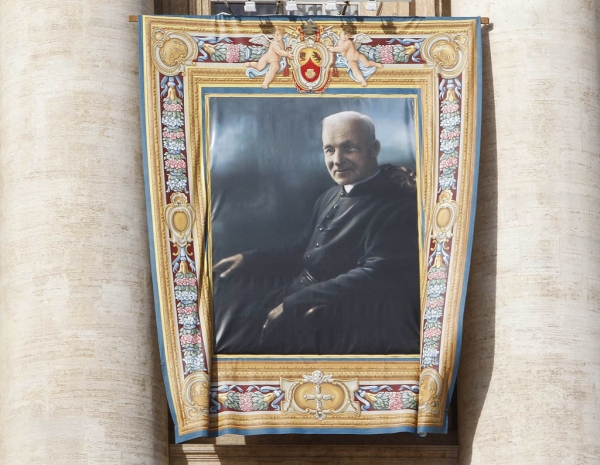
Les saints ont fait briller le visage du Christ dans leur vie, à travers leurs actions, leurs paroles et par leurs intercessions; et Dieu continue son travail à travers leur intercession même après leur mort.
Saint Thomas d’Aquin, par le travail de toute sa vie, nous a montré la sagesse de Dieu révélée dans les Écritures Saintes.
Saint Dominic, par sa vie et ses prédications, nous a témoigné le Christ qui enseigne le monde, le Christ qui fait la proclamation de la Bonne Nouvelle.
Saint François d’Assise, par sa vie et à travers sa fraternité, nous a montré le Christ pauvre et crucifié. Il a appelé Jésus « le frère ». François nous a invité à vivre pleinement le mystère de l’Incarnation en appelant Jésus son « frère ». Jésus est notre frère, c’est le mystère de l’incarnation : Dieu fait home.
Aujourd’hui nous célébrons frère André. Par son accueil, sa compassion et son intercession, il nous a montré le visage de Dieu qui nous écoute, qui nous accueille et qui nous guéri par sa Grâce.
Il faut comprendre L’homme selon son époque, selon son temps.
Comme notre archevêque cardinal Jean Claude Turcotte l’a bien observé dans son homélie au stade olympique le 30 octobre 2010 (dernier) :
« Le frère André a vécu à une époque bien différente de la nôtre. Mort en 1937, il n’a rien connu ni rien prévu des profondes transformations survenues dans notre société et notre Église depuis les années 1960.
À divers égards, sa façon de penser, sa manière de se comporter, ses propos, les expressions de sa foi chrétienne et de sa piété diffèrent des nôtres. Il est d’une autre époque, peut-on dire. »
Mais malgré ces différences, même aujourd’hui, nous sommes tous attiré par sa vie.
Sa vie nous parle de la compassion, de l’écoute et de l’Intercession.
Aimer…écouter….prier.
« Mange - Prie - Aime » nous dit Mme Gilbert Elizabeth dans son livre autobiographique au succès international et par le film du même nom, qui a connu un énorme succès aux cinémas à travers le monde de l’an dernier (en 2010.)
Par sa vie, saint frère André nous invite à « Aimer…écouter….prier. »
Toute sa vie, il s’est caché derrière le manteau de Saint Joseph.
After the great European Freeze, read on the great Indian onion crisis. This is a re-post from BBC India's Soutik Biswas' blog. interesting.....
Stink over onion crisis is enough to make you cry Soutik Biswas | 12:35 UK time, Wednesday, 22 December 2010
A spectre is haunting India - the spectre of an onion-less life.
Onion prices have shot through the roof this week, climbing to an eye-watering 85 rupees ($1.87; £1.20) a kilo from 35 rupees only last week. Crop damage due to unseasonal rains has apparently led to a shortage. Traders have been hoarding stockpiles of the staple food to make a killing, despite official threats to punish them.
A fretful government has banned exports till mid-January to bring prices down, and cut import duties on the vegetable. The prime minister, we are told, is busy writing letters imploring his farm and consumer affairs ministries to bring down prices quickly. The opposition is breathing fire.
Onions have stormed their way to the front pages of newspapers and the top of TV news bulletins. I counted two dozen stories on onions in a dozen-odd English papers today. One editorial chides the government for the price rise and asks it to "know your onions". "UPA [United Progressive Alliance, another name for the ruling Congress-led government] lands in onion soup", is a particularly colourful banner headline in another paper. "Onions: Weep till March", bemoans yet another headline, alluding to a minister's deadline to fix the crisis. And a tabloid's onion edit - teasingly called "More at work than onions" - is strategically placed between one on a corruption scandal besieging the government and another on the sizzling alleged affair between the British actress Liz Hurley and the Australian cricketer Shane Warne.
Chefs and cookbook writers have come out in droves giving out free tips on how to cope without onions. "My advice, especially to those who want to eat out," says one chef, "would be to shift to different cuisines for a while as onions are primarily used in Indian cooking." So try European and other Asian foods, he advises. At home, he says, substitute onions with tomatoes and curds. Onion lovers may not find that a very convincing answer.
Everyone is concerned about the prospect of life without onions in India. Most worried of all are the politicians. In 1998, onion inflation was partly blamed for the unseating of the Hindu nationalist BJP government in Delhi's state polls. Political pundits insist that steep onion prices also contributed to the now-defunct Janata Party's debacle in the 1980 general elections.
So why do high onion prices drive Indians up the wall and unseat governments? One onion exporter said to a paper: "Why does the consumer never compare prices of onions with those of other vegetables? No vegetable is available at less than 40 rupees a kg in the retail market."
It's simple. Onion is a vegetable that no Indian kitchen can do without. It is also the most egalitarian of vegetables. A poor peasant or worker's sparse meal is incomplete without a bite of the pungent bulb. The onion is pureed, satueed, fried and garnished in the rich man's feast as well. It also occupies a unique culinary space in Indian cooking.
It is a must for adding taste and crunch to many vegetarian and non-vegetarian dishes. It is eaten raw as a salad, pureed for flavouring and sauce for meats and garden vegetables; used as a dip; fried as fritters and crisps. Rustic medicinal beliefs have it that it has healing properties and reduces acidity. Indians believe onions cool the body in the searingly hot summers and keep fungal infections away during muggy monsoons. In the old days Hindu widows kept away from onions after their husbands' deaths as the humble bulb was believed to have aphrodisiac qualities. How can you possibly compare such an exalted vegetable with any other?
This is official: Manorama IPAD APP is coming!
this is a re-post from on kerala by Dr. Mario R. Garcia.
Kerala: an enchanted land with millions of newspaper readers!
TAKEAWAY: This is an industry that needs good, encouraging news, right? Well, take a detour to Kerala, in the scenic cone of southern India, a sort of Land of Oz for newspaper readers.
Recent front page of Malayala Manorama
It has been an intense two days here at Malayala Manorama, the newspaper that is read by approximately 10 million readers daily.
Yes, it takes your breath away just to mention that number in connection with a printed newspaper—-or in any platform for that matter.
My visit here this time has nothing to do with print. We at Garcia Media did a full redesign of Malayala Manorama (in Malayalan) and its sister weekly magazine The Week (in English) in 2004.
Figures just released today, tell us the happy story: Malayala Manorama retains the number 1 position among regional language dailies in India with 99.27 lacs readers (approximately 10 million). With this reanking, Malayala Manorama becomes the 4th largest read newspaper in the country, and the only non-Hindi publication in the top 5 list.
The honor of being number one, the most widely read newspaper in India is Dainik Jagran (Hindi) with close to 16 million readers, followed by Dainik Bhaskar (Hindi), 14 million; Hindustan——a current Garcia Media project—-with almost 11 million. The Times of India (English) is #7 on the list and the most widely read English language daily, with over 7 million daily readers.
By the way, another one of our Indian regional newspaper projects, Sakshi (in Telugu), published in Hyderabad, and which we created as a newspaper in March 2008, ranks #15 on the list with close to 5 million daily readers.
Indian readers take their newspapers seriously, and although the use of mobile telephones is widespread, they are used for conversation more than to read newspapers in them, obviously. As I have travelled through the rural stretch that connects the city of Cochin with Kottayam in scenic Kerala, I was impressed by the number of men and women sitting outdoors, or on the floor, with a newspaper open in front of them.
Are you listening, Ross Dawson?
Dawson, as readers of this blog may know, is the author of a much discussed Newspaper Extinction Deadline. In it, India truly got the honors of being the last country to say goodbye to printed newspapers as we know them.
According to Dawson, it will be India that will pull the plug, sell the old printing presses, turn off the light and hang a sign that reads: Gone apping!
Dawson’s website is about “opportunities for business and society in a hyper-connected world.
I am surprised that so many Indian publishers had no idea they were so honored. Twice this month, while conducting sessions, I have joked that I expect to be working in India till the very end of my career. Heck, I will be 93 in 2040 if I make it that far. But I don’t think I, or anyone, will be helping the Indians to hang that sign outside the door. However, I see surprise in the Indians’ faces when I tell them they have been given the honor of being the last country to still have printed newspapers.
“Nonsense,“ a publisher told me here. “Pure nonsense, this prediction.“ (I have heard the same reaction from others outside of India)
Not even an hour after this discussion came the report with those incredible, but true, numbers about Indian newspaper readership: 15 million readers here and 10 million there. The newspaper that was #33 on the list , Punya Nagari (in Marathi) even gets two million readers.
“We at Malayala Manorama see various platforms, and we are going to be represented in all of them,“ says Mammen Mathew, Editor
And, of course, Mr. Mathew made this statement as he joined us in the kick off of the Malayala Manorama iPad app workshop.
Six years after my first visit here to redesign Malayala Manorama, my visit this time is to help Malayala Manorama as it looks to the future in a new platform—-the tablet.
The iPad workshop
Many ask me what my IPad workshop involves. As I have just completed today here in Kerala, let me share the information with you:
Two days, that is what it takes to get a group of devoted members of the iPad project team ready to understand how the tablet works, how print and online relate to the tablet, how to create a model.
First, the workshop is scheduled as Phase One of the iPad project, once the management has decided to go iPad—-or at least to explore its grand possibilities.
The two-day workshop involves the following:
--Introduction: a presentation of about 90 minutes outlining all that we know about the iPad and how to get started in the creation of a news app.
-Exploring the existing publiation’s DNA: a discussion of the strenghs of the newspaper or magazine and how to enhance them and give them longer legs on the app.
Sketching: first basic aspects of sketching. I am a firm believer that the discussion of what will be cannot go too far without screens showing it.
Information architecture: a key part of the workshop, involving the entire team, but especially the technical ones, how navigation will be carried out; how do we move from here to there; the maps that lead us to our destinations inside the app. Perhaps the most important point of the workshop.
A final working sketch: at the end of the two days, we have a full working sketch with the main parts of the architecture, content flow, visual details (tyography, color palette) and the basics of storytelling.
Of special interest
The Great Murdoch iPad Debate | The New York Observer
http://www.observer.com/2010/great-murdoch-ipad-debate
Why the iPad should rival the web
http://www.ft.com/cms/s/0/6130938a-fd85-11df-a049-00144feab49a.html?ftcamp=crm/email/2010122/nbe/MediaInternet/product#axzz16wE3T2UF
USA: Wall Street Journal Magazine, New York Section Profitable, CEO Hinton Says
http://www.bloomberg.com/news/2010-12-02/wall-street-journal-magazine-new-york-section-profitable-ceo-hinton-says.html
TheMarioBlog post #684
Posted by Dr. Mario R. Garcia on December 02, 2010
WikiLeaks Cable Gate: "This child is destined to cause the falling and rising of many in Israel, and to be a sign that will be spoken against,so that the thoughts of many hearts will be revealed...."( Luke 2:33-35)
Wikileaks cablegate is an important event in our recent history.
It is important not because of its content alone, but also because of the reactions it generates, short-term as well as long-term.
It reveals the thoughts of many hearts, to the grand public. This is a way of viewing the world in all its colors possible...the fears, the doubts, the silences, the silent wishes...
anyway, Hello world, have a great cablegate journey!
point of WikiLeaks Dec 1st 2010, 22:54 by W.W. | IOWA CITY
DAVID BROOK's recent column and Ross Douthat's reply to my defence of WikiLeaks have helped me to pin down and articulate the source of a nagging but previously inchoate sense that somehow we're all missing the bigger picture.
Let me start by suggesting that the politicians and pundits calling for Julian Assange's head are playing into his hands. As all eyes track the international albino of mystery, the human and physical infrastructure of a much larger, more distributed movement continues to expand and consolidate far beyond the spotlight. If Mr Assange is murdered tomorrow, if WikiLeaks' servers are cut off for a few hours, or a few days, or forever, nothing fundamental is really changed. With or without WikiLeaks, the technology exists to allow whistleblowers to leak data and documents while maintaining anonymity. With or without WikiLeaks, the personel, technical know-how, and ideological will exists to enable anonymous leaking and to make this information available to the public. Jailing Thomas Edison in 1890 would not have darkened the night.
Yet the debate over WikiLeaks has proceeded as if the matter might conclude with the eradication of these kinds of data dumps—as if this is a temporary glitch in the system that can be fixed; as if this is a nuisance that can be made to go away with the application of sufficient government gusto. But I don't think the matter can end this way. Just as technology has made it easier for governments and corporations to snoop ever more invasively into the private lives of individuals, it has also made it easier for individuals, working alone or together, to root through and make off with the secret files of governments and corporations. WikiLeaks is simply an early manifestation of what I predict will be a more-or-less permanent feature of contemporary life, and a more-or-less permanent constraint on strategies of secret-keeping.
Consider what young Bradley Manning is alleged to have accomplished with a USB key on a military network. It was impossible 30 years ago to just waltz out of an office building with hundreds of thousands of sensitive files. The mountain of boxes would have weighed tons. Today, there are millions upon millions of government and corporate employees capable of downloading massive amounts of data onto tiny devices. The only way WikiLeaks-like exposés will stop is if those with the permissions necessary to access and copy sensitive data refuse to do so. But as long as some of those people retain a sense of right and wrong—even if it is only a tiny minority—these leaks and these scandals will continue.
The basic question is not whether we think Julian Assange is a terrorist or a hero. The basic question certainly is not whether we think exposing the chatter of the diplomatic corps helps or hinders their efforts, and whether this is a good or bad thing. To continue to focus on these questions is to miss the forest for the texture of the bark on a single elm. If we take the inevitability of future large leaks for granted, then I think the debate must eventually centre on the things that will determine the supply of leakers and leaks. Some of us wish to encourage in individuals the sense of justice which would embolden them to challenge the institutions that control our fate by bringing their secrets to light. Some of us wish to encourage in individuals ever greater fealty and submission to corporations and the state in order to protect the privileges and prerogatives of the powerful, lest their erosion threaten what David Brooks calls "the fragile community"—our current, comfortable dispensation.
KOLKATA – On the evening of 16 August 1948, Mother Teresa removed her Loreto Sisters (IBVM) religious habit (dress) and wore a cheap new habit of her future ‘Missionary of Charity’ Order. Her new dress consisted of a simple, cotton, white sari with blue stripe (blue is the color of Virgin Mary) along with white habits to be worn under the sari. (Please see right side photo and notice the single striped sari). For over ten years Mother Teresa and her Missionaries of Charity Sisters used the single border sari until few pious parents of some Bengali MC Sister protested at the lack of decorum of their daughter’s religious habit. In those days, the single blue border white sari was worn by poor sweeper women working for Calcutta corporation.
Mother Teresa ( single stripe sari) with Bishop Morrow and Miss Eileen Egan of CRS in Calcutta, May 1960.
It was at this time that the American born Salesian Bishop Louis Morrow (1939-1969) of neighbouring Krishnagar diocese founded the Sisters of Mary Immaculate (SMI) on 12 December 1948. It was Bishop Morrow who developed three striped blue border white cotton sari for his Sisters, after more than two years of study, consultation and trials. The SMI Sisters had their first solemn clothing ceremony in April 1952 when they wore their current sari with three blue stripes for the first time.
It was in May 1960 that Mother Teresa approached Bishop Morrow, to seek his permission to adopt the SMI sari design for the MCs.
“More the merrier,” the delighted Bishop was reported to have told Mother Teresa encouraging her to use the SMI style sari! Since then the MC Sisters use the SMI design sari but wear it in the rural Bengali women’s style. Today the MC Sisters sari is produced at the MC run leper colony in Titagarh, outside Kolkata.
Novices wear white saris without the blue stripe. They also receive the blue striped sari when they profess. A Sister’s possessions include: three saris (one to wear, one to wash, one to mend), a pair of sandals, flour sack underclothes (used to be), a crucifix and rosary. They also have a plate and metal spoon, a canvas bag, and prayer book. In cold countries, possessions also include a cardigan. They never wear anything but sandals on their feet.
The death toll from a cholera outbreak in Haiti has leapt past 250, officials say.
More than 3,000 people were infected, said Gabriel Thimote, director general of Haiti's health department.
Five cases of cholera were detected in the capital Port-au-Prince but UN officials said the patients had been quickly diagnosed and isolated.
Around a million survivors of January's quake are living in tents near the city with poor sanitary conditions.
Health officials have been trying to contain the outbreak in areas north of the capital.
The five victims isolated in Port-au-Prince had become infected in the Artibonite region - the main outbreak zone - and then travelled to the capital where they developed symptoms, the UN's humanitarian affairs agency said.
This meant Port-au-Prince was "not a new location of infection", it added.
Aid officials have described the prospect of a cholera outbreak in the city as "awful".
Those in the camps are highly vulnerable to the intestinal infection, which is caused by bacteria transmitted through contaminated water or food.
Cholera causes diarrhoea and vomiting leading to severe dehydration, and can kill quickly if left untreated through rehydration and antibiotics.
07/10/2010 (1:12)
La foi chrétienne et la communication ont en commun une structure fondamentale : le fait que message et moyen coïncident ; en effet le Fils de Dieu, le Verbe incarné, est à la fois le message de salut et le moyen par lequel le salut se réalise. Ceci n’est pas un simple concept mais une réalité accessible pour tous. Il constitue un moyen pour contraster l’indifférence face au Vrai, la spectacularisation à tout prix. Benoît XVI l’a réaffirmé dans son discours aux participants du congrès international de la presse catholique organisé par le Conseil pontifical pour les Communications sociales. L’Eglise, a-t-il dit, alimente la capacité à nouer des relations plus fraternelles et plus humaines, s’offrant comme lieu de communion entre les croyants mais aussi comme signe et instrument, pour tous, de vocation à la communion. Face à la crise religieuse actuelle, le monde de la communication catholique doit s’engager davantage car, a dit le Pape, même s’il n’a pas de force pour y croire, le monde a besoin de vivre comme si Dieu existait, autrement il risque de ne produire qu’un humanisme inhumain. C’est pour cela qu’il faut des communicateurs crédibles, efficaces, qui croient de façon authentique.
Clôture à Rome du congrès mondial sur la presse catholique organisé par le Conseil Pontifical pour les communications sociales. Jesús Colina, président d’H20news et directeur de ZENIT donne un avis d’expert sur les réseaux sociaux, et sur leurs risques et avantages pour les catholiques.
Jesús Colina: “La production de contenus réalisés directement par les internautes a généré ces dernières années des services à gros succès come : Wikipedia, Youtube, Facebook, Twitter. Flicker, Google News... Même Open Source est une forme d’interactivité et de production partagée ».
Jesús Colina estime que le modèle web2.0 a une marge de risque pour ainsi dire « relativiste ». Il se demande alors de quelle façon les communicateurs catholiques devraient adopter le modèle de l’interactivité?
Jesús Colina: « L’objectif de toute l’initiative web 2.0 se base sur la mise en place d’une community”.
Sur Internet, la communication doit suivre le modèle de l’Eglise comme communion, auquel Benoît XVI consacre son pontificat.Quand une Eglise transmet par Internet le sens de la communion, c’est-à-dire de manière interactive, elle fait la communauté. Dans ce cas Internet cesse d’être un espace virtuel pour se transformer en une opportunité de rencontre»
A Carleton University professor throws new light on the Prince of Darkness, Jennifer Green reports
By Jennifer Green, The Ottawa Citizen September 25, 2010
The devil is not who we think he is. In fact, for much of ancient history, he wasn't even a "he," says Kimberly Stratton, who is teaching a new Carleton University course on the history of Satan.
The earliest Biblical references use "satan" as a verb, meaning to block or prevent something.
In the Book of Numbers, an angel blocks or "satans" Balaam from cursing the Israelites. "In the original Hebrew, the verb is to 'satan' him," says Stratton. "The angel himself was a normal angel of God." In the Book of Job, "satan" is a job title, something like a Crown prosecutor who seeks sinners and brings them to justice.
"He is still an angel in God's court. There is no indication that he is an opponent of God. He just seems to be an angel doing his job. If anything, he has a higher-ranking position in heaven." Even in the New Testament's Gospel of Matthew, the Devil tests Jesus in the desert, but then he disappears, and ministering angels come in. "So it's not clear there that he isn't still part of God's entourage. ... acting somehow as the Crown attorney." Stratton outlines in her course how man's ideas of God and goodness, evil and misfortune, are shaped by history.
In 586 BC, the Babylonians sacked Jerusalem, destroyed the temple, the sole place of Jewish sacrifice, and dragged the nation into exile.
Once there, they tried to reconcile their misfortune with God's justice. They also started to believe there was only one God -- their own.
"If your god uses other nations to punish you, he must be in charge of those other nations and if he's in charge of those other nations, he must be more powerful than those other gods," says Stratton. "Eventually, you conclude there is just one god." The other gods became characterized as demons, traced back to the race of giants mentioned in Genesis, the offspring of "fallen angels" who came down from heaven and mated with human women. Stratton stresses that this is the only mention in the Bible of fallen angels, later stories notwithstanding.
The early church father Origen of Alexandria first suggested several hundred years after Christ's death that Satan fell because he refused to bow down to humans.
We also hear that he is the snake in the garden, trying to tempt Adam and Eve, but we are never told why, says Stratton.
"We're left with some guy who's evil for no reason. He is just an opponent of God, out to create havoc and ruin the world and ruin mankind, just because." In the Middle Ages, the devil becomes a useful tool for inflicting horrific measures against whoever might be in the way. If Jews or women or Knights Templar control too much of the economy, don't submit to their husbands, or own too much land, those in control could accuse them of worshipping Satan, making it perfectly acceptable to seize their goods, torture them, and burn them at the stake.
In the 16th century, as Protestants broke away from the Catholic Church, both competed to enforce moral reform, clamping down on women in particular.
"So there starts to be this association that women are running amok, striving to overthrow their husbands, and overturning domestic duties. They are so sexually insatiable they have to go to the devil to be satisfied." Once they have sold themselves to the devil purely for sexual reasons, they are in his thrall.
In preparation for the course, Stratton spent the better part of one summer looking at movies about Satan. Her favourite, Bedazzled, a 1967 movie with Dudley Moore, is surprisingly close to the Old Testament.
"(Satan's) job is to throw little things in (people's) way, to see how they react, and whether they roll with it and manage to keep their faith." Six years later, The Exorcist scorched the popular imagination. But, as creepy as it was, offers a surprisingly lazy devil. "This is the arch enemy of God and the worst he has to offer is a girl swearing and masturbating?" Al Pacino's Satan in The Devil's Advocate calls himself the first humanitarian, and offers this critique of religion: "God gives you all these desires and passions and then he gives you all these rules: look but don't touch, touch but don't taste, he's up there laughing." The devil in Mel Gibson's The Passion of the Christ is so androgynous that Stratton figures the director was linking Satan with homosexuality, another vilified group.
One scholar on Stratton's recommended reading list argues that Satan is not really that important, not even in the Bible.
Nor is he all that evil, writes Henry Ansgar Kelly in Satan: A Biography.
Kelly, distinguished professor emeritus in UCLA's English department, calls for a return to the original biblical view of Satan as a sort of prosecuting attorney rather than an embodiment of evil bent on destroying humankind.
Kelly says the latter characterization of Satan tars God with the same dark brush: "The ... vilification of Satan as the great enemy of God, to whom God delivered the entire human race for punishment, casts God not as the merciful father of the gospels but as an inept and irrational tyrant." Christ's sacrifice redeems relatively few, leaving millions of others, conceived and born in the state of guilt without having committed any personal sin, to suffer in Hell forever.
Le pasteur Terry Jones aura réussi à retenir l’attention des médias avec sa menace de brûler le Coran.
En faisant le jeu d'un pasteur en mal de brûler le Coran un 11 septembre 2010, les médias ont-ils failli provoquer un grave incident? Avant même que Terry Jones n'ait pu mettre son projet à exécution, plusieurs ont posé la question. Le président Barack Obama, ayant pressenti le danger, hésitait à donner trop d'importance au personnage. Mais comment un pareil type, hier inconnu, a-t-il pu retenir ainsi l'opinion mondiale?
En juillet, à l'annonce de sa «Journée internationale pour brûler le Coran», le chef spirituel du Dove World Outreach Center n'avait guère capté l'attention des médias. Certes, un site «athée» avait noté la parution d'une page sur Facebook. Et aux États-Unis comme à l'extérieur, une vidéo placée sur YouTube le 17 juillet avait provoqué des réactions. Parmi les premiers à s'y intéresser, on relève le blogue d'un Michael Tomasky au Guardian de Grande-Bretagne.
Deux jours après, une association américaine d'Églises évangélistes diffusait, il est vrai, une déclaration pressant le groupe de Jones d'abandonner son idée de brûler des exemplaires du Coran. Mais, le 31 juillet, une entrevue du pasteur intégriste à CNN lui donnait une tribune internationale. Une agence de presse ayant relevé cette nouvelle affaire de Coran, plusieurs médias la mentionnèrent, dont le Times of India!
Au début d'août, le Sun de Gainesville — 115 000 habitants, et site de l'Université de Floride — interviewe le maire, Craig Lowe, qui réprouve le comportement du pasteur. Et les citoyens qui s'expriment semblent, pour la plupart, du même avis. Or, d'après une des analyses de cette étrange initiative, même si le débat se poursuit alors sur les réseaux sociaux ainsi qu'à la télévision et à la radio, l'histoire n'a pas encore pris une importance internationale.
Les uns attribuent l'escalade à la distribution de corans gratuits par le Conseil des relations américano-islamique. D'autres trouvent plutôt que David Petraeus, chef des forces de l'OTAN en Afghanistan, a mis le feu aux poudres en intimant à Jones de cesser de mettre en danger la vie de soldats et de civils à l'étranger. Des journalistes l'ayant interrogée, la secrétaire d'État, Hillary Clinton, a condamné, bien sûr, l'autodafé. Il ne restait plus au secrétaire à la Défense, Robert Gates, puis au président lui-même qu'à interpeller Jones pour que l'homme devienne un acteur mondial.
Qui est responsable alors de ce délire collectif, la presse ou la Maison-Blanche?
La presse a raté une bonne occasion d'examiner la source de cette «nouvelle». Quelle compétence théologique, en effet, permettait à Jones — qui n'a jamais étudié l'islam — de condamner le Coran ou de dicter aux musulmans où bâtir une mosquée? Quelle expérience à titre de «pasteur» l'autorisait à presser les adeptes de la vraie foi de «se tenir debout»? Aucune. Il aura fallu que son bûcher soit à la veille de flamber pour que des médias s'intéressent au passé du personnage.
Qui est-il ?
Cet ancien gérant d'hôtel a pris la direction, il y a 15 ans, d'une petite secte fondée par un homme d'affaires en 1986. Avec son épouse, il en habitait une grande propriété, mais surtout y gérait une entreprise de meubles, vendus sur eBay. Ses ouailles ne dépassaient pas la cinquantaine. Et dans une «académie» attenante, des pensionnaires s'occupaient aussi à travailler pour l'entreprise du pasteur.
D'après des rapports de presse en Allemagne, Jones y a été associé à une «communauté chrétienne» à Cologne, avant d'en être écarté. Son style de leadership était contesté, ainsi que son diplôme de théologie, obtenu d'une école biblique non reconnue. En Floride, sa petite Église s'était donné un mandat universel, comme son site le proclame, mais elle n'avait guère de succès.
Jones a certes publié un livre dont la page titre affirme que «l'islam vient du Diable». Mais ses affaires vivotaient. Les autorités locales de Gainesville mettaient en question son statut fiscal. Le moment pour le prophète de frapper un grand coup n'était-il pas venu? Avec tous ces musulmans osant implanter une mosquée à deux pas de Ground Zero, Dieu lui en aura, dit-on, donné l'inspiration.
L'Amérique s'éveillant au péril, le pasteur de Gainesville allait enfin fournir de quoi la galvaniser. Pourtant, rappellent des chroniqueurs, il n'aura pas été le premier à lancer l'idée d'un autodafé du Coran. Plus tôt, en 2008, un pasteur de la Westbobo Baptist Church de Topeka, au Kansas, en avait brûlé un exemplaire en pleine rue, et immortalisé la scène sur un film. Même illustré, l'événement, pourtant, ne fit pas le tour du monde. Les médias n'en avaient pas fait une nouvelle.
(Radio-Canada fit mention de cette Église de Topeka, — non reconnue par la confession baptiste — quand certains de ses membres, déjouant les gardes-frontières, vinrent au Manitoba, à l'occasion des funérailles d'une victime d'acte criminel. Ce crime était la punition de Dieu pour la tolérance de l'avortement, de l'homosexualité et autres plaies sévissant au Canada.)
Cette fois, les médias n'auraient probablement pas parlé de Jones si son projet, circulant sur les réseaux sociaux et sur les stations qui y prennent leur pâture, n'avait ameuté un plus grand public. Quand le public s'émeut, les médias s'agitent, et les politiciens également. C'est ainsi qu'un pasteur sans envergure, mais friand de notoriété, a réussi à kidnapper jusqu'au président des États-Unis.
Bref, ce «media event» spectaculaire mais débile n'aurait obtenu qu'une mention à la chronique des incidents loufoques, si les médias s'étaient le moindrement enquis du triste curriculum de Terry Jones. Par contre, en donnant une grande visibilité à une violence symbolique, ils risquaient de provoquer ailleurs des réactions extrêmes qui, elles, auraient été fort réelles.
***
redaction@ledevoir.com
***
Jean-Claude Leclerc enseigne le journalisme à l'Université de Montréal
Ouvrant l’Évangile, chacun peut se dire : ces paroles de Jésus sont un peu comme une lettre très ancienne qui me serait écrite dans une langue inconnue ; comme elle m’est adressée par quelqu’un qui m’aime, j’essaie d’en comprendre le sens, et je vais aussitôt mettre dans la pratique de ma vie le peu que j’en saisis…
Ce ne sont pas les vastes connaissances qui importent au début. Elles auront leur grande valeur. Mais c’est par le cœur, dans les profondeurs de soi-même, que l’être humain commence à saisir le Mystère de la Foi. Les connaissances viendront. Tout n’est pas donné d’un seul coup. Une vie intérieure s’élabore pas à pas. Aujourd’hui plus qu’hier, nous pénétrons dans la foi en avançant par étapes.
Au tréfonds de la condition humaine repose l’attente d’une présence, le silencieux désir d’une communion. Ne l’oublions jamais, ce simple désir de Dieu est déjà le commencement de la foi.
De plus, personne ne parvient à comprendre tout l’Évangile à lui seul. Chacun peut se dire : dans cette communion unique qu’est l’Église, ce que je ne comprends pas de la foi, d’autres comprennent et en vivent. Je ne m’appuie pas sur ma foi seulement mais sur la foi des chrétiens de tous les temps, ceux qui nous ont précédés, depuis la Vierge Marie et les apôtres jusqu’à ceux d’aujourd’hui. Et jour après jour je me dispose intérieurement à faire confiance au Mystère de la Foi.
Alors il apparaît que la foi, la confiance en Dieu, est une réalité toute simple, si simple que tous pourraient l’accueillir. Elle est comme un sursaut mille fois repris tout au long de l’existence et jusqu’au dernier souffle.
( post updated on 22 /06/2014, to include the original speech transcript at the end)
This week i heard Bishop Kenneth Ulmer speaking about a chess-painting, most probably by Friedrich Moritz August Retzsch on Goethe´s Faust.
Eric S. Ritz writes this note about this picture :
On display in the magnificent Louvre Museum in Paris, France, is that dramatic painting of Goethe's Faust. Faust is seated at a table engaged in a competitive game of chess. And at first glance, it looks like Faust is losing. His opponent in the chess game is Satan. The devil sits there grinning smugly. He thinks he has the victory in hand. He is pointing at the chessboard with an evil leer and he is gloating.
As you look at the painting, you can almost hear the devil shouting: "Checkmate! Game’s over! I win!"
However, a person with a keen eye who knows the game of chess can see that the match is not over at all. As a matter of fact, just a few years ago, an internationally famous chess player was admiring the painting when all of a sudden he lunged forward and exclaimed: "Wait a minute! Look! Faust has another move and that move will give him the victory!"
There is no place for God in theories on the creation of the Universe, Professor Stephen Hawking has said.
He had previously argued belief in a creator was not incompatible with science but in a new book, he concludes the Big Bang was an inevitable consequence of the laws of physics.
The Grand Design, part serialised in the Times, says there is no need to invoke God to set the Universe going.
"Spontaneous creation is the reason there is something," he concluded.
'Planetary conditions'
In his new book, an extract of which appears in the Times, Britain's most famous physicist sets out to contest Sir Isaac Newton's belief that the universe must have been designed by God as it could not have sprung out of chaos.
Continue reading the main story
Citing the 1992 discovery of a planet orbiting a star other than our Sun, he said: "That makes the coincidences of our planetary conditions - the single Sun, the lucky combination of Earth-Sun distance and solar mass - far less remarkable, and far less compelling as evidence that the Earth was carefully designed just to please us human beings."
He adds: "Because there is a law such as gravity, the universe can and will create itself from nothing.
"Spontaneous creation is the reason there is something rather than nothing, why the universe exists, why we exist.
"It is not necessary to invoke God to light the blue touch paper and set the universe going."
The book was co-written by US physicist Leonard Mlodinow and is published on 9 September.
In his 1988 bestseller, A Brief History of Time, Prof Hawking appeared to accept the role of God in the creation of the Universe.
"If we discover a complete theory, it would be the ultimate triumph of human reason - for then we should know the mind of God," he said.
Even as Kerala is named the best travel destination in Asia, we bring you 25 reasons to visit God's Own Country. That is, if you haven't already.
Kerala Tourism got a boost when the million-plus readers of the acclaimed travel portal, SmartTravelAsia.com, placed the state as the best Asian holiday destination ahead of Bali, Phuket and the Maldives in a poll conducted over 3 months across Asia (India, Singapore, Australia, Hong Kong, China, Japan, Malaysia, Thailand, Philippines, and the Middle East), Europe and North America.
"This is a phenomenal recognition for Kerala and the people who are working in the tourism sector," said V. Venu, secretary, Kerala Tourism.
The only other Indian destinations to be listed in the top 10 were Rajasthan and Goa - at eighth and 10th spot respectively.
So, here's why you should pack your bags and get those tickets for Kerala.